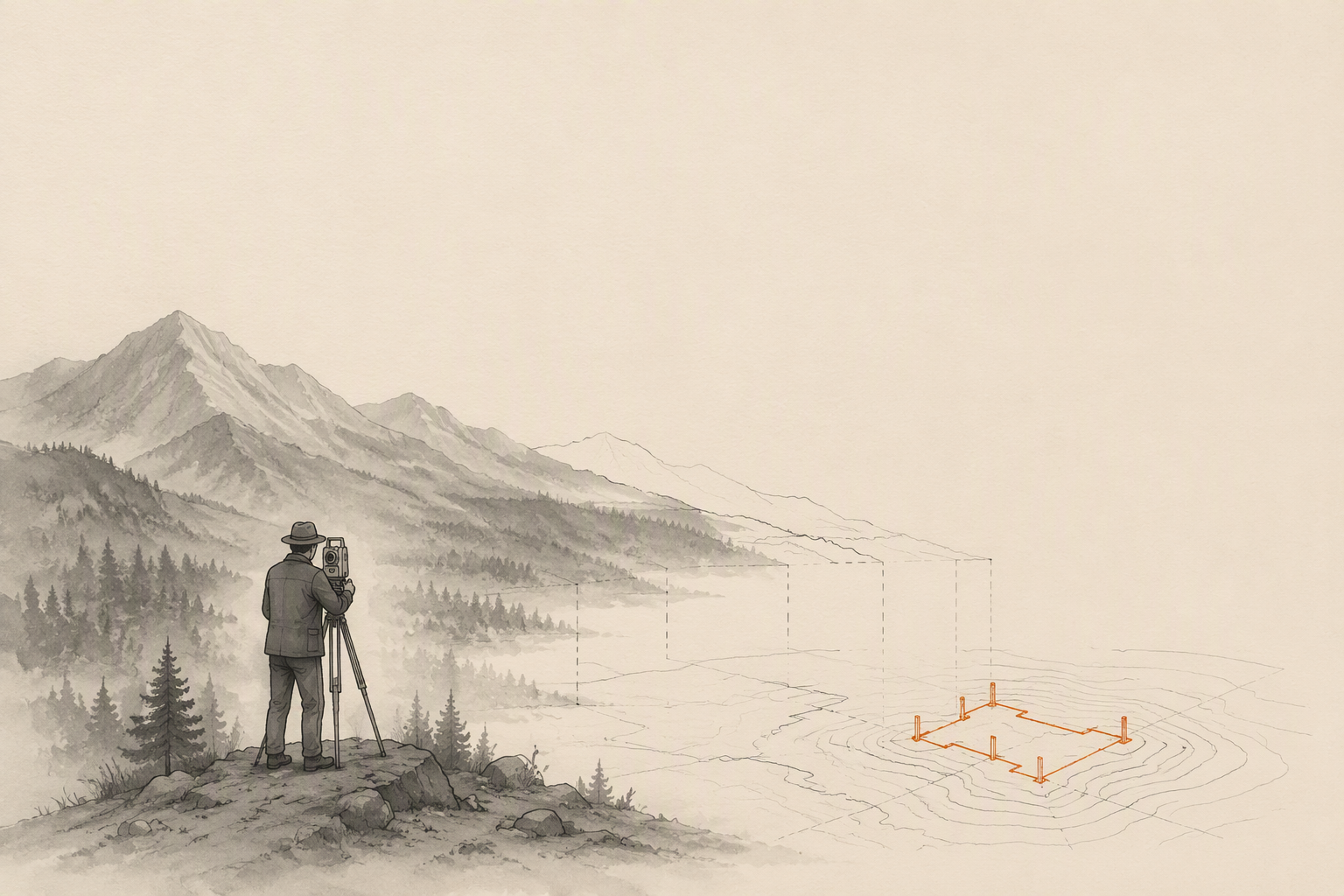
There is a distinction that almost everyone agrees with in principle and almost no one applies in practice: the map is not the territory. We know this. We can say it fluently. And then we walk into a meeting and spend forty minutes debating whether a statistical reduction faithfully represents the data it reduced, as though the whole point wasn't that it doesn't.
The confusion is understandable. Models feel authoritative. A visual representation of ten thousand single data points, colored by cluster, has the aesthetic of a finding rather than a choice. A logistic regression predicting hospital readmission looks like knowledge rather than a probabilistic judgment. When something is rendered visually, numerically, formally, it becomes easy to mistake the rendering for the thing rendered. The map starts to feel like the territory. And once it does, we begin making a specific and very costly error: demanding from the model a fidelity it was never designed to provide.
This is a category error, and it has consequences.
What Models Are Actually For
A model is a deliberate distortion. This is not a flaw to be corrected. It is the mechanism by which models work. You simplify in order to see. You omit in order to focus. You impose structure because structure is what makes a system legible, actionable, tractable. The moment you demand that a model reproduce reality without distortion, you have asked it to become reality, which is both impossible and useless. Reality is already available. It's what you were trying to understand.
This applies with equal force to the Apgar score and the proposed mechanism of action written on a drug's package insert. None of these is true in the way a photograph is true. All of them are useful in the way a good map is useful: they highlight what matters for a particular purpose and suppress what doesn't. The pharmacokinetic model doesn't capture everything that happens between a patient swallowing a tablet and the drug reaching its target. It captures enough to make dosing decisions. That's a different standard, and a more honest one.
The question is never whether a model distorts. It always does. The question is whether it distorts in ways you understand, and whether it fails in ways you can anticipate.
Models, Expertise, and Compression
A useful model is not one that captures reality perfectly. It is one that captures enough of reality to support a decision.
In pharmacovigilance, a signal is not proof. A disproportionality in a reporting database may reflect a real safety concern, reporting bias, random variation, or several things at once. The analyst knows this. The value of the signal is not that it reveals the phenomenon directly, but that it highlights where attention should be directed. The map is useful precisely because its limitations are understood.
The same principle applies to expertise itself.
There is a common belief that expertise is primarily the accumulation of knowledge. Under this view, the difference between a novice and an expert is simply the number of facts stored in memory. In practice, something more interesting happens. Over years of experience, facts become compressed into patterns. The clinician no longer consciously retrieves every relevant rule before making a decision. The data scientist no longer evaluates every assumption from first principles. Both begin to recognize structures that would have required deliberate analysis earlier in their careers.
This is why expert judgment can be difficult to articulate. The reasoning has not disappeared. It has been compressed. What once required a checklist now resembles perception.
This also explains why expertise cannot simply be transferred by handing someone a manual. The manual contains the knowledge. It does not contain the compression.
The important consequence is that expertise is not the absence of simplification. It is the ability to work with simplifications intelligently. An expert understands what a model can see, what it cannot see, and which uncertainties matter for the decision at hand. The map remains incomplete. The difference is that the expert knows where its edges are.
Compressed Judgment
Virginia Apgar designed her score in 1952 precisely because she had watched too many newborns die quietly while the delivery room's attention was elsewhere. Obstetricians, she observed, were exercising judgment, but inconsistently, and sometimes too late. The score she created was a deliberate simplification: five observable signs, each rated zero to two, a number that could be read in sixty seconds. It was obviously incomplete as a description of neonatal physiology. It was exactly right as a map for a specific decision under time pressure.
What happened next is the more interesting part. Within a generation, experienced neonatologists stopped consciously computing the Apgar. They looked at the infant and they knew. The score had been internalized, compressed from a checklist into something closer to perception. The checklist scaffolded the judgment until the judgment no longer needed the scaffold.
Expertise is not the accumulation of facts. Facts can be looked up. It is the learned capacity to know which unknowns are dangerous to ignore and which are safe to leave open. It is judgment that has been compressed, through practice, into something fast enough to be useful.
The compression is the point. A system that required every uncertainty to be resolved before a decision could be made would not be more rigorous. It would be paralyzed. The challenge is not eliminating uncertainty but deciding when the remaining uncertainty is acceptable. The map narrows the possibilities. Judgment determines whether what remains is enough.
The Map and the Person Reading It
The remedy is not recklessness, nor the abandonment of evidence, nor the dismissal of uncertainty. Governance matters. Validation matters. Rigorous processes exist because they have prevented real harms. But the goal of all that checking, all that rigor, all that careful accumulation of evidence, is not to delay the decision indefinitely. It is to reach the point where a competent person can look at what is known, acknowledge what is not known, and say: this is enough.
This is why AI in healthcare holds genuine promise: not as a system that removes judgment from the loop, but as one that gives judgment better maps to work from. A sepsis prediction model does not replace the clinician. It narrows the space of possibilities. The clinician still reads the patient.
A model that flags deterioration earlier, surfaces a drug interaction, or identifies a subpopulation at risk is doing exactly what a good map does: it marks the territory so that someone competent can navigate it. The value is not in the flag. It is in what the expert does next.
Organizations that forget this, that treat algorithmic output as the end of the process rather than the beginning of it, do not become more careful. They become less capable. They build systems that are efficient at generating recommendations and poor at knowing when the recommendation is wrong. They select for people who follow the map and against people who can read the terrain.
The territory is always more complex than the map. That is why the map exists, and why the person holding it still matters.