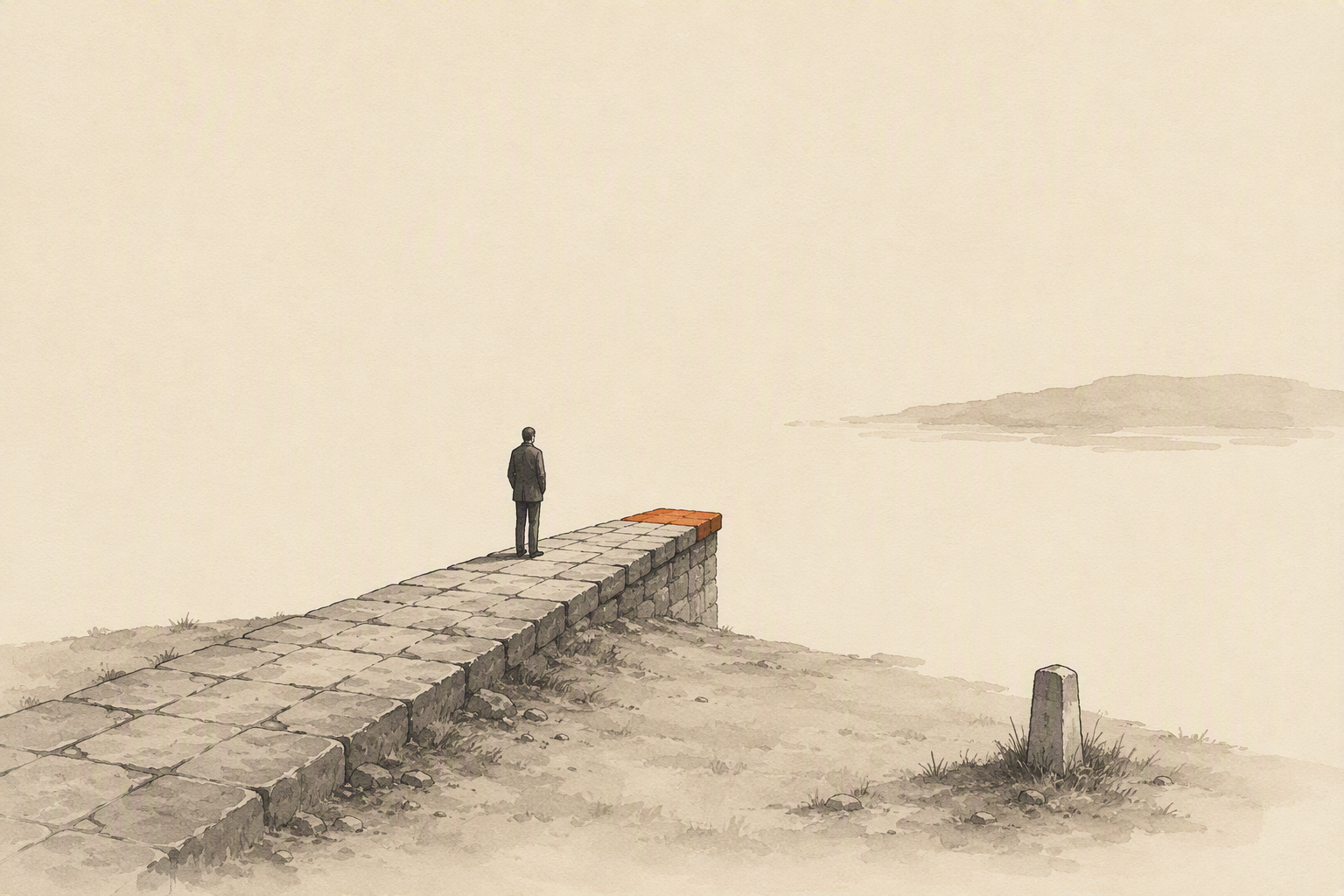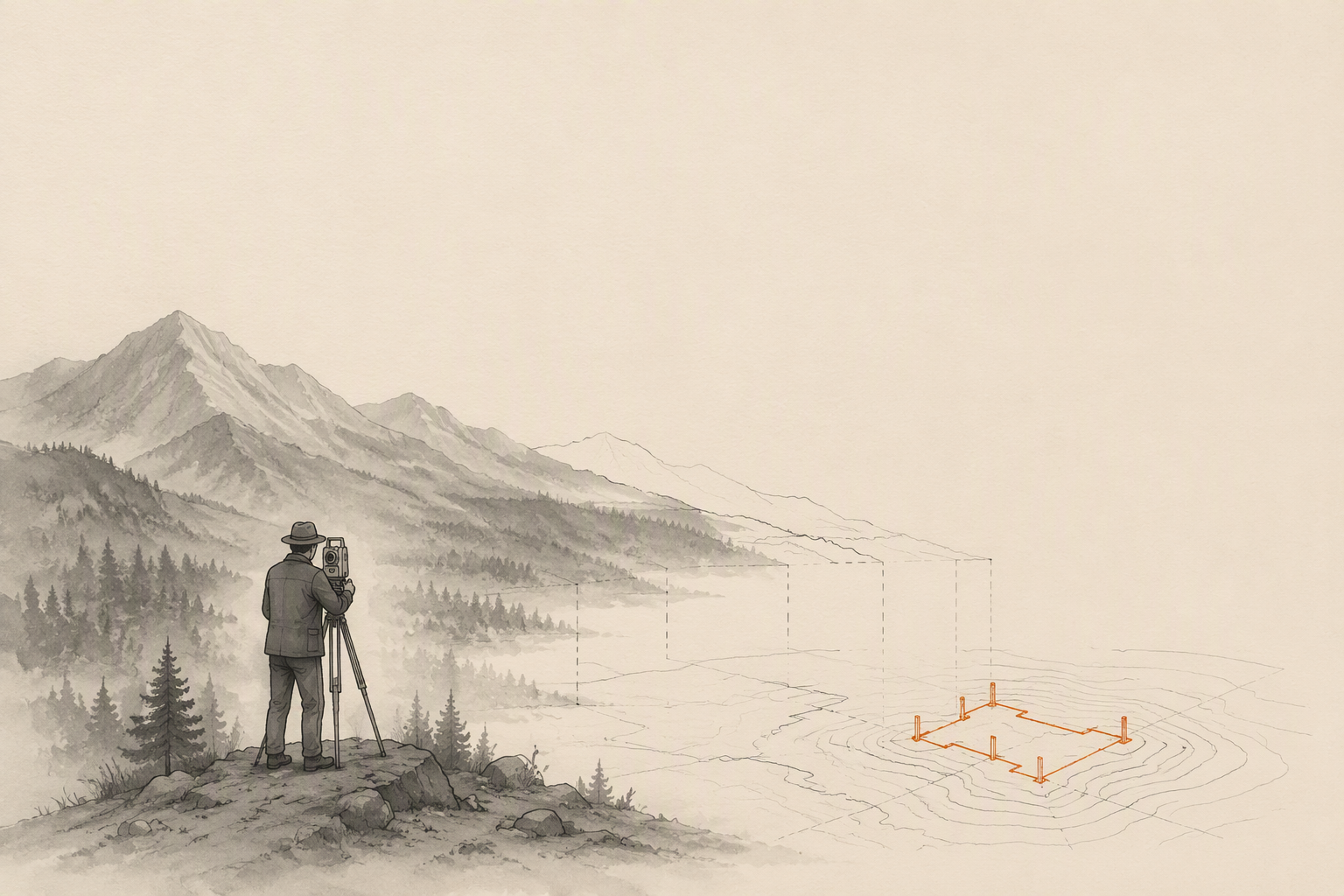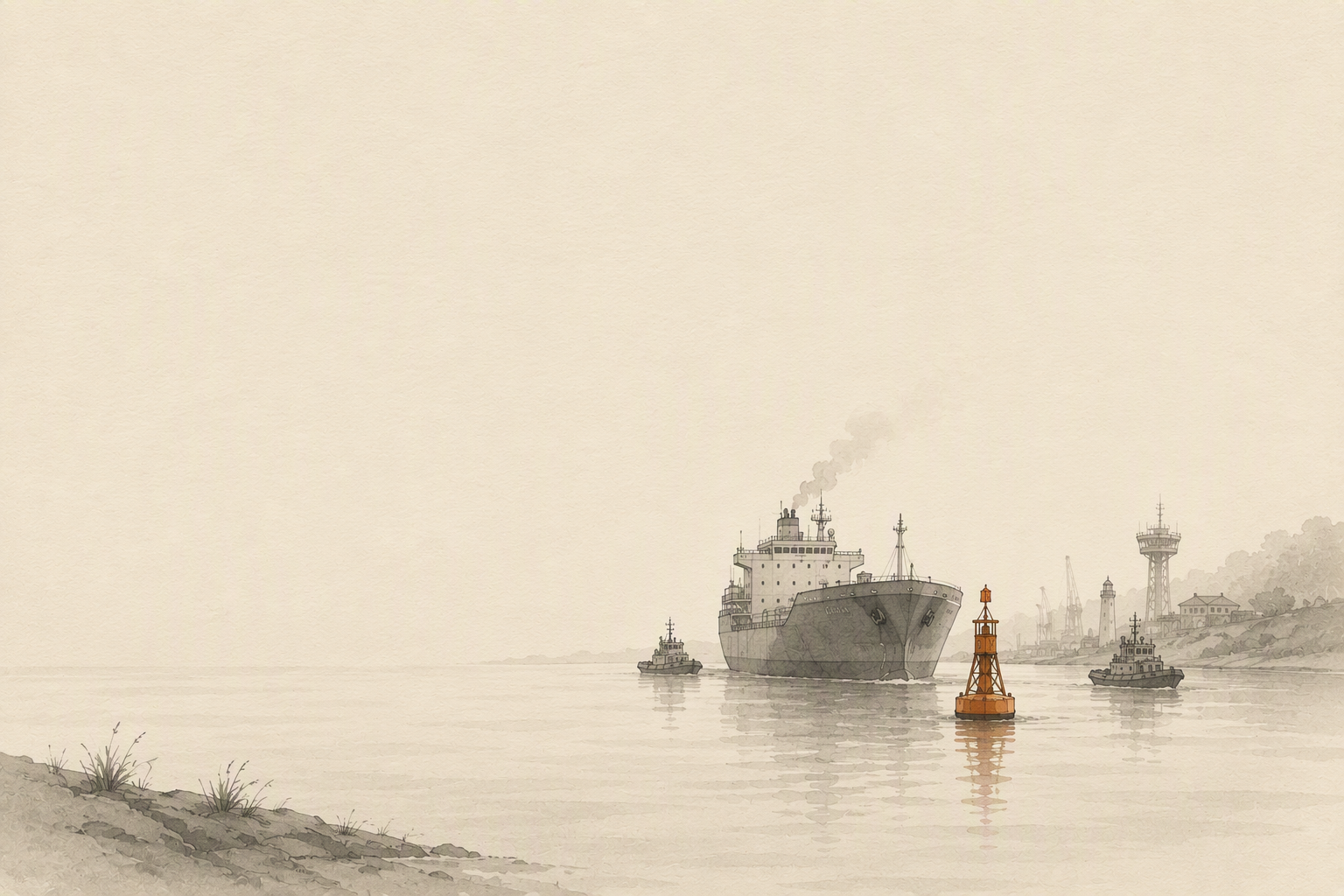
Last month, on a rooftop in Berlin, somewhere between the second round of drinks and the point where conversations stop being polite, a colleague asked me a question that sounded simple and turned out not to be. Does AI actually want to complete a task, and will we always be the ones handing it the next one? My answer came out faster than I'd actually thought about it: no, it doesn't want anything, it doesn't need to want anything, because it doesn't die. For us, there is always a risk in doing tomorrow what we could have done today. For it, there isn't.
That answer is too easy on its own, so let me be precise about what is actually missing, because the imprecise version invites objections that miss the point entirely. It is not intelligence. It is not memory. It is not even autonomy, in the sense of acting without a human pressing a button at every step. What is missing is urgency, and urgency, in every case we know of, is a consequence of being a system that has something to lose. Humans experience time as scarce because we know we run out of it. Machines do not run out of anything, and that changes everything downstream of it.
My colleague used the word motivation, but I think the more precise concept is what psychologists call drive. Pressure generated by a body that has drifted from equilibrium, hunger, thirst, pain, not a goal anyone chooses. That pressure is what has nowhere to attach inside software. A model can be given goals. Hunger is something different.
What the Body Already Knows
That pressure is manufactured at the cellular level before it ever reaches consciousness. Most of your cells are already scheduled to die on a timetable. Skin cells survive only weeks. Intestinal epithelial cells turn over within days. The cells that escape this turnover, that forget how to stop dividing, are usually the ones we call cancer. Apoptosis is not a malfunction, it is the default, and a body that lost the ability to make its own cells die on schedule would not live longer, it would grow a tumor. Layered on top of this is the reward architecture, dopamine and cortisol, the apparatus that turns a homeostatic deviation into a felt sense that something needs attention now.
Here the analogy to machine learning gets uncomfortably close, and it is worth sitting with the discomfort rather than resolving it too fast. In the late 1990s, Wolfram Schultz, Peter Dayan, and Read Montague showed that dopamine neurons do not simply fire when something good happens. They fire in proportion to how wrong your prediction was, encoding what is technically called a reward prediction error. That is almost exactly the mathematical object that temporal difference learning computes in reinforcement learning, a field that borrowed the structure quite openly.
So it is fair to ask: if the equation is the same, why isn't the machine equally urgent? The answer is that the equation was copied, not the stakes.
A dopamine neuron sits inside an organism that can starve, get eaten, or fail to reproduce if the prediction keeps being wrong. A reward signal inside a model sits inside nothing that can lose anything at all.
It is not only that the organism can lose something and the model cannot. It is that the model has no experience of the interval in between. Nothing about later is experienced at all. A human does not discount a future reward merely because death is possible somewhere down the line. The discounting happens because waiting itself is felt, as impatience, as anticipation, as the specific discomfort of not yet. Take away the felt experience of duration, and there is nothing left to discount.
On the machine side, what actually happens is worth stating plainly rather than waving at. Training a model is a finite optimization process. Gradient descent adjusts parameters against an objective, with a clear start and, eventually, a clear stop. Once training ends, the parameters are frozen. Deployment is something else entirely, a fixed set of weights sitting inert until an input arrives. Current foundation models spend almost all of their existence in precisely this resting state. Nothing in that resting state is pursuing an objective, wanting anything, or losing anything by staying at rest.
The distinction is not humans have goals and machines only have rewards, which is too simple, since most of our own reward architecture is inherited rather than self-authored too. We did not choose to find sugar rewarding or ostracism painful; evolution and culture assigned us that. The sharper distinction is this. Humans are embedded in their objectives, inside a body that stands to gain or lose from how the objective plays out.
Evolution is also an optimization process imposed from outside, but unlike training it never truly stopped. Every generation remained exposed to the same selection pressures because the next decision could still determine whether an organism survived and reproduced. A model’s training, by contrast, is already over by the time anyone interacts with it. Its weights are the sediment of an optimization that has already finished. Running the model carries none of the risk that kept the pressure alive for us.
The Donkey, Updated
Four centuries ago, Descartes described animals as automata. Bodies executing mechanical responses to stimuli. How literally he meant this is more contested than the popular version suggests, so I will not lean on it, but history largely judged him wrong. Animals hunger, explore, hesitate, and avoid pain because they possess the biological machinery that gives rise to drive. Ironically, software now occupies a position much closer to Descartes’ automaton than any living animal ever did.
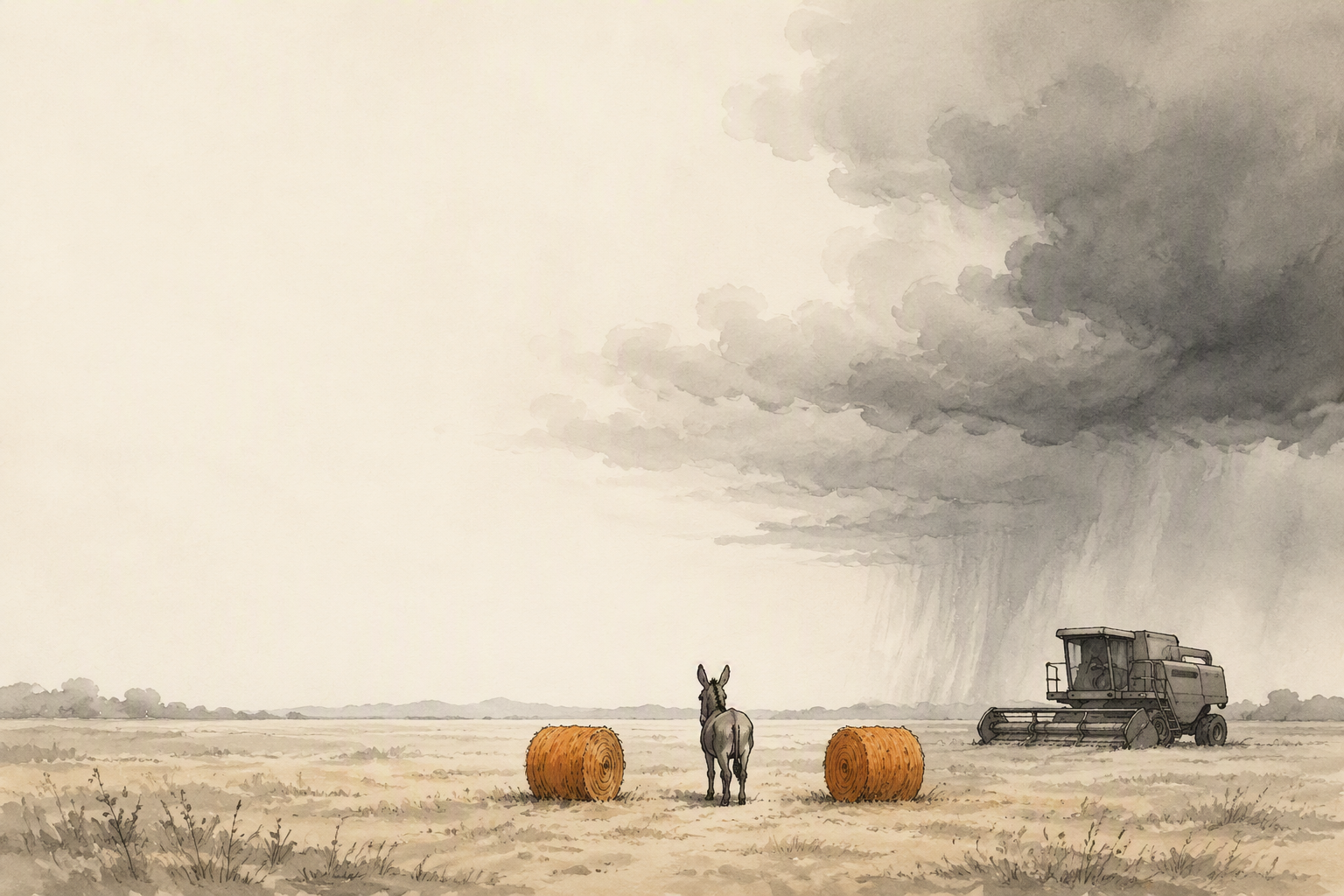
The image that captures all of this best is older than Descartes: Buridan's donkey, placed exactly between two identical piles of hay, unable to find a reason to choose one over the other, and starving as a result. Put a model between two equally weighted tasks, two prompts of identical priority, and it will not break the tie through its own reasoning either. What is missing is what decision theory calls a tie-breaking mechanism, an internal preference that resolves equally weighted options. Many deployed systems do break ties, through sampling temperature, top-p cutoffs, or a random seed, and that is real, worth naming honestly. But a system that samples from a distribution to produce an output is not expressing a preference. It is manufacturing an outcome.
Living organisms never approach Buridan’s dilemma perfectly symmetrically. Biology continuously injects asymmetries. Hunger grows, fatigue accumulates, fear intrudes, attention drifts. Software possesses no comparable source of internal imbalance. Randomness is not preference. The donkey's tragedy was that indecision killed it. The model's condition is that indecision costs it nothing at all, which is a stranger kind of trap.
This is not only a philosophical flourish. Reinforcement learning researchers ran into the literal version of this problem decades ago. An agent working toward a sparse reward, one that only fires after a long sequence of correct actions, has no reason to explore in the meantime, for the same reason nothing pulled Buridan's donkey toward either pile. The response researchers built is telling. Artificial curiosity, an explicit bonus reward for encountering unfamiliar states, an idea Jürgen Schmidhuber proposed in the early 1990s and that Pierre-Yves Oudeyer's work on developmental robotics later extended considerably.
An entire subfield built around manufacturing curiosity reveals something worth pausing on. Exploration had to be designed. It did not emerge on its own, simply because the system got more capable. Nothing inside the agent made waiting costly.
Borrowed Urgency
I see the same gap in the two professional worlds I have actually worked inside. A pharmacovigilance system can flag a disproportionality signal, a drug and an adverse event occurring together more often than chance would predict. It cannot decide whether that signal is strong enough to justify opening an investigation, whether reporting bias explains it away, or whether regulatory action is warranted this quarter rather than next. That decision is made by a person or a committee, on a schedule that has nothing to do with when the model happened to notice the pattern.
The same gap is starker in acute care. A sepsis prediction model can calculate that a patient's risk has crossed a threshold. It cannot know that the emergency department is boarding twenty patients tonight, that the attending physician is already inside another resuscitation, or that an escalation at three in the morning carries a different operational reality than the same escalation at noon. The model produces a number. A person decides whether the number, tonight, in this department, means now.
Call this borrowed urgency. Every escalation rule, every threshold, every review cycle is a piece of human urgency installed into software that generates none of its own.
The obvious objection today is agentic AI: systems given memory, long running tasks, and permission to act without a human confirming every step. Surely persistence over time is exactly the endogenous urgency this essay says is missing. It helps to separate two words that get used interchangeably and should not be. Autonomy is acting without direct intervention at each step. Agency is having goals, preferences, and reasons of one's own for holding them. A self-driving car is autonomous inside its domain. That tells you nothing about whether it has agency. It might choose the faster of two roads because traffic data says so. It will not choose the coastal road because the sunset over the water is beautiful.
An agentic AI system, in exactly the same way, is operationally autonomous. It can loop, retry, and act across long stretches of time without a human present at every cycle. That architecture creates persistence. It does not create the origin of a goal. A system can contain mechanisms that produce persistence, memory, self-triggering loops, but those mechanisms remain part of an architecture someone else designed. Someone, or something, still has to decide that now is the moment, and hand that decision to the system from outside, whether the trigger is a human, a cron job, or another model checking in on a timer. The persistence is implemented. It is not experienced.
Heidegger argued that human mortality is not simply a biological endpoint we happen to have, a fact filed away somewhere and mostly ignored. He called it being-toward-death. The claim that we do not just run out of time, we exist in a constant, usually unacknowledged awareness that we are running out of time, and that awareness is what turns mere possibility into urgency. You do not need the rest of his vocabulary to use this one idea. It draws a sharper line than biology alone does, between an organism that has an expiry date and one that additionally knows it, and knows the date can arrive early. Nothing resembling that second-order awareness exists anywhere in a model, however convincingly it can describe the concept if you ask it to. Biology explains why organisms evolved under pressure. Heidegger adds something biology alone cannot. Humans do not merely live under that pressure. They experience it. We know time is finite, and we act inside that knowledge.
Why Now?
Much of the current conversation about agentic AI replacing coordination work quietly assumes that motivation comes bundled with capability. It does not, and the omission is not a minor technical footnote. It is the whole reason organizations will keep employing people whose job is substantially about timing rather than execution: knowing when to escalate, when to wait, when a decision that looks ready is not actually ready. Reasoning has become cheap. Deciding that this is the moment to apply it has not, and nothing on the current roadmap suggests it will.
We have gotten very good at teaching machines to think. We have barely started asking why they would ever decide, on their own, that now is the time to think. A machine can measure time perfectly. It simply has nothing to lose by letting it pass. That difference is not about intelligence. It is about judgment, and judgment begins where waiting has a cost.